


Blog
Adult Learning Principles Explained: A Trainer’s Guide to Andragogy

Try sitting a room full of adults through a lecture built for sixteen-year-olds. Watch how fast the attention goes. It isn’t stubbornness; adults simply process information differently than children do, and training that ignores this, however well-meaning, tends to lose the room inside ten minutes.
That difference has a name: andragogy, the study of how adults learn. It’s not academic box-ticking. It’s the reason one session lands and another, built from near-identical content, quietly falls flat.
What Is Andragogy?
Andragogy is the art and science of helping adults learn. Pedagogy, by contrast, concerns children. The term is older than most people assume. The German educator Alexander Kapp coined it back in 1833, though it took the American theorist Malcolm Knowles to popularise it in the 1970s and build it into the framework most trainers use today.
Knowles’ argument was straightforward: adults don’t learn like children. Training built on a child’s assumptions, passive reception, and information handed down from an authority figure falls flat with professionals who walk in carrying their own experience, their own motivations, and more than a little scepticism. Knowles pushed for a shift from teacher-centred instruction to learner-centred facilitation. That shift still holds up.
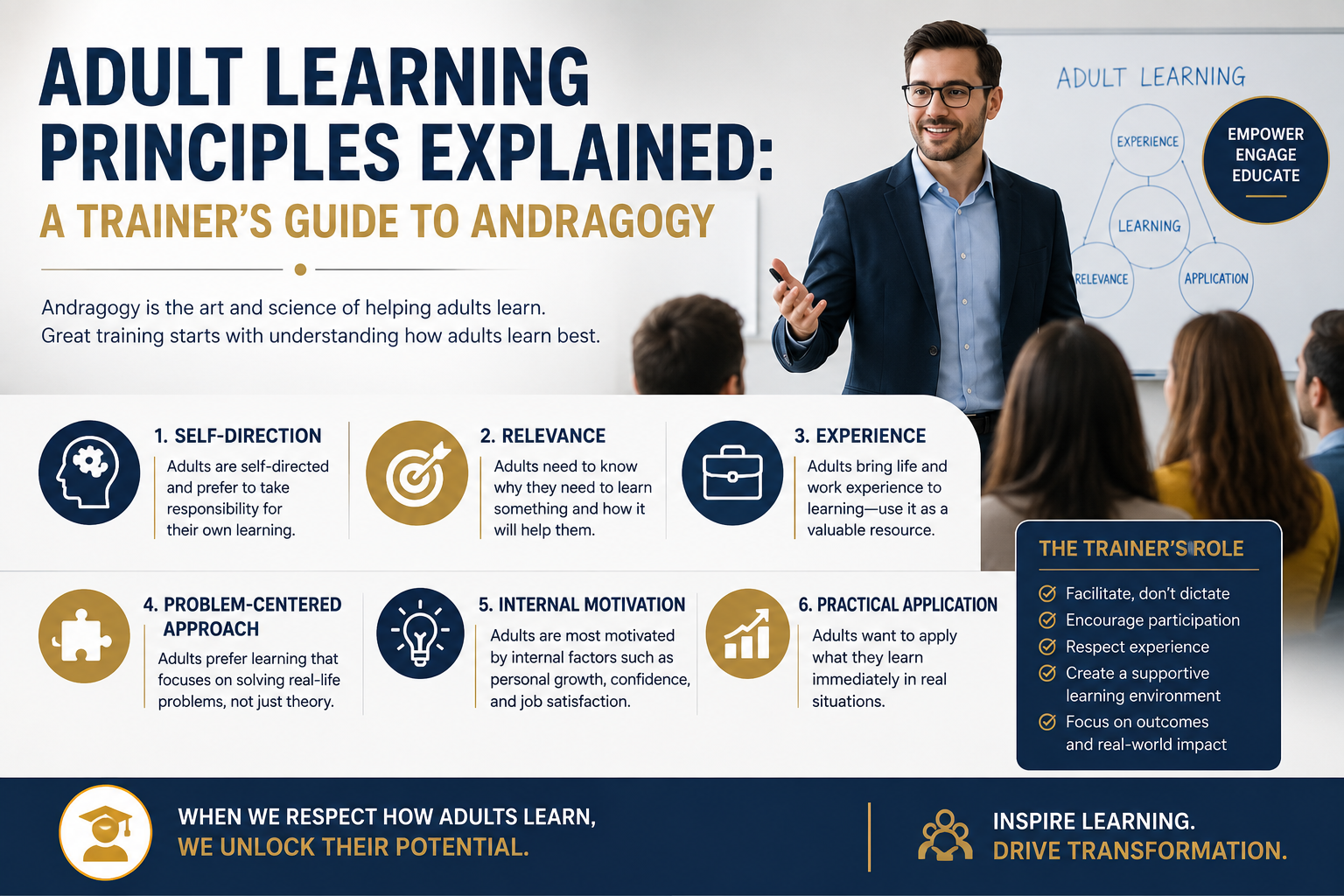
The Six Principles of Adult Learning
Knowles boiled his theory down to six principles. None of them is abstract. Each one has a direct, practical use in how you build and run a session.
The Need to Know
Adults want the “why” before they’ll commit to the “what.” A child might follow an instruction simply because a teacher gave it. An adult is quietly asking, “What’s in this for me?” and if that question goes unanswered, attention drifts fast.
How to apply it: Open with relevance, not content. Connect the material to something the learner genuinely needs, a qualification, a workplace risk, or a step up in their career before you dive into the detail.
Self-Directed Learning
Most adults see themselves as capable of steering their own learning, and they push back against being treated as passive recipients. It’s one of the sharper divides between adult and child learners; kids more readily accept a directive, teacher-led structure.
How to apply it: Offer a choice, wherever it’s reasonable, which case study to tackle first, and how to approach a practical exercise. Position yourself as a facilitator guiding the room, not a lecturer talking at it.
Experience as a Learning Resource
Adults show up with a body of life and professional experience that children simply haven’t had time to build yet. That’s one of your richest teaching resources, though it can occasionally work against you. Deeply held assumptions are a lot harder to shift than a blank slate.
How to apply it: Pull the group’s experience into the session on purpose. Peer discussion, shared examples, and structured reflection on past situations all of it puts that experience to work instead of talking past it.
We learned this one the hard way. Early on, we ran a course as if the room were a blank page, when in fact half the group had years of frontline experience between them. The material didn’t land until we opened the floor to their examples instead of only ours. Ignoring the room’s existing knowledge doesn’t make training more rigorous; it just makes it worse.
Readiness to Learn
Adults get ready to learn when they hit a real need to know or do something, a job change, a new responsibility, or a gap they’ve spotted in their own performance. You can’t just announce readiness. You have to meet it where it already exists.
How to apply it: Time training, where you can, to land alongside a genuine trigger, a new role, an upcoming requirement, a recent incident, rather than delivering it purely because a schedule says it’s due.
Problem-Centred Orientation
Children tend to be subject-centred learners. Adults are problem-centred or task-centred. New knowledge sticks best framed against a real-world application, not filed away as abstract theory for “someday.”
How to apply it: Build sessions around case studies, scenarios, and problems the learner will actually face rather than presenting concepts in isolation and hoping the application becomes obvious later.
Internal Motivation
External rewards, such as a pay rise or a promotion, do matter. But the research on adult motivation keeps landing on the same conclusion: internal drivers carry more weight. Self-esteem. Career progression. Quality of life. A plain sense of achievement.
How to apply it: Frame the learning around what it means for the person, not just the organisation. A supportive environment that builds confidence will consistently outperform one leaning on external incentives alone.
How Adult Learners Differ From Children
Knowles’ framework rests on five underlying differences:
- Self-concept (self-directed, not dependent)
- Experience (richer, more varied)
- Readiness (triggered by need, not by a schedule)
- Orientation (problem-centred, not subject-centred),
- Motivation (internal, not external)
None of this makes adult learners harder to train. It makes them different to train, and that distinction is worth holding onto.
Common Mistakes Trainers Make With Adult Learners
The most frequent misstep? Applying pedagogy to a room full of adults lecturing instead of facilitating, ignoring the experience already sitting in the chairs, marching through abstract theory without anchoring it to real application, never quite explaining the “why” before launching into the “what.” Every one of these is fixable. Each maps straight back onto one of the six principles above.
Beyond Andragogy: Other Theories Worth Knowing
Andragogy isn’t the only lens on offer, and it’s worth knowing where it sits next to other adult learning theories. David Kolb’s experiential learning model, from the 1980s, frames learning as a repeating cycle of concrete experience, reflection, abstract conceptualisation, and active experimentation. Handy for any session built around hands-on practice. Jack Mezirow’s transformative learning theory goes further still: it’s less about skill-building and more about how a genuinely disorienting experience can reshape a learner’s underlying assumptions and worldview, not just their competence.
Think of andragogy as the map, and these other theories as different routes across the same terrain. You don’t need to pick one for good. Different sessions, different learners, different combinations.
Applying This in Practice
None of this has to be complicated. At the design stage: build learning objectives around genuine relevance, draw on participants’ experience on purpose, root activities in real problems rather than abstract theory. During delivery: open with the “why,” act as a facilitator rather than a lecturer, and stay alert to the different learning preferences sitting in the room. At assessment: keep it grounded in real application, and make feedback specific enough that someone can actually act on it.
It’s a useful discipline to apply to any of our own courses, including something as hands-on as the Full SIA Door Supervisor qualification, where the “why” is rarely abstract. Learners already understand, often better than the trainer does, exactly why the content matters for their next shift.
Putting Andragogy to Work
Understanding how adults actually learn changes what a session looks like from the inside: less lecture, more facilitation. Less abstract theory, more real problems. Less telling, more drawing out what the room already knows. It’s a shift worth making deliberately, session by session, not one you can assume will happen on its own.
If you’re building the confidence to apply these principles yourself, our Train The Trainer course covers andragogy in depth, alongside the practical facilitation skills that bring it to life in the room.
FAQs
What are the six principles of adult learning?
Malcolm Knowles recognised six: They have to know why they are learning something, they prefer to learn by themselves, they need to draw on previous learning, they need to respond when they have a real need, they have a problem-centred approach, and they are internally motivated rather than externally motivated.
What is the difference between andragogy and pedagogy?
Andragogy is a subject that deals with adult learning, which is self-directed, experience-rich, problem-centred and internally motivated. Pedagogy is about how children learn, usually in a more teacher-led and content-based manner.
Who developed the theory of andragogy?
It was a term coined and developed by Alexander Kapp in Germany in 1833, and popularised and developed by Malcolm Knowles in the 1970s, and his name is still most closely associated with it.
Why do adults learn differently from children?
Adults have a different self-concept, a larger pool of experience, readiness that is solicited and not programmed, a problem-centred orientation, and more internal motivation, which influence the design and delivery of training.
Why is it important to explain the "why" to adult learners?
Before adults give their attention to what they are learning, they must be able to understand the relevance and benefit. An explanation of the “why” immediately engages student interest and reduces the drift that occurs when they lose interest in learning.
What is problem-centred learning?
It involves making training relevant to real-life problems and scenarios and not just a theoretical body of knowledge, as adults learn best from what is directly applicable to them.
This is custom heading element
These six principles are still applicable when working in writing: make it relevant right from the start; allow for self-directed options (e.g., choice of pace or module sequence); allow for discussion and the sharing of experiences; make use of problem-centred activities; allow for personal motivation (e.g., progress and recognition).
How do adult learning principles apply to online training?
In addition to andragogy, it is important to be familiar with Kolb’s experiential learning cycle (learning by doing) and Mezirow’s transformative learning theory (learning that changes the underlying assumptions and worldview).