


Blog
Essential Skills Every Successful Trainer Needs

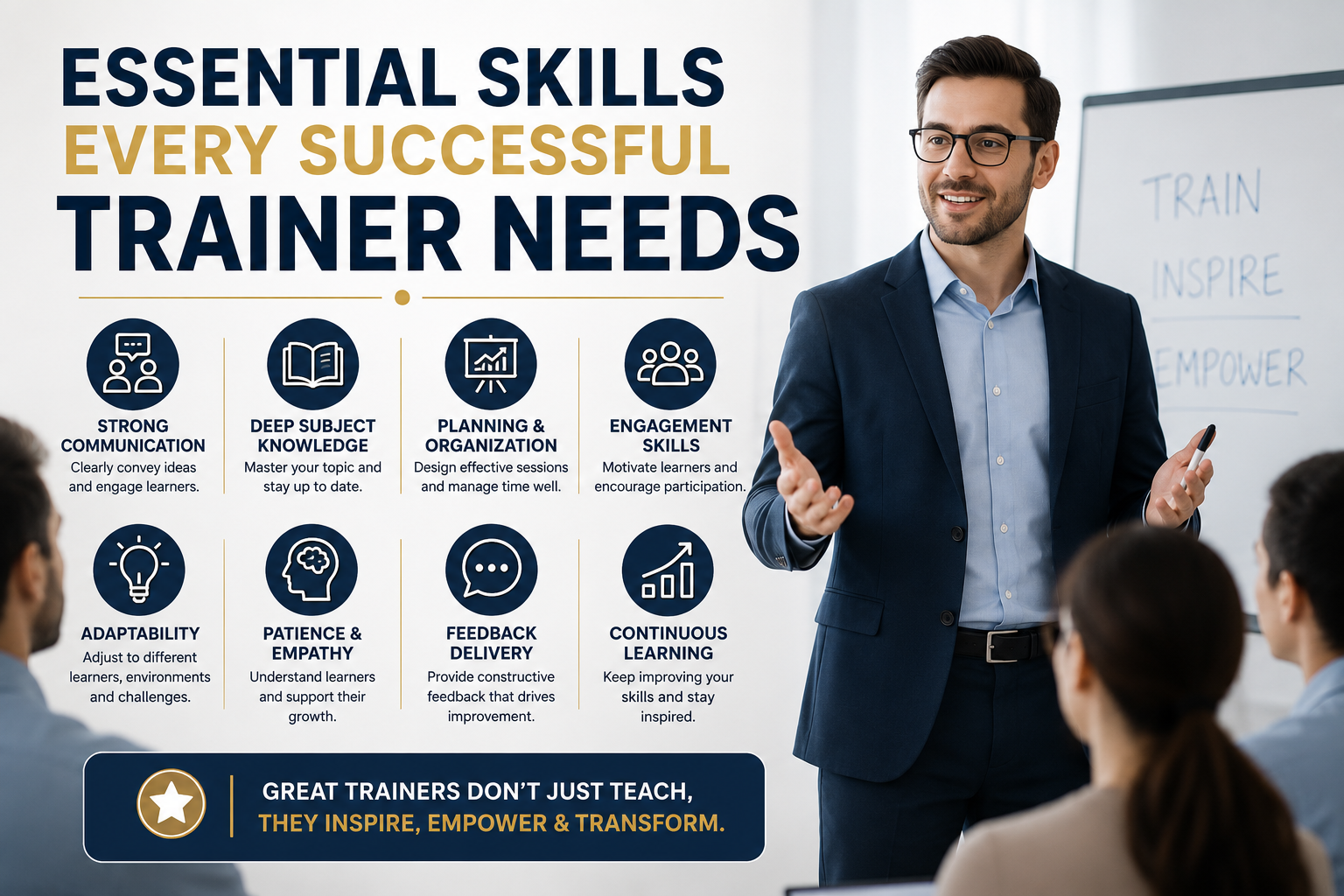
Picture two trainers delivering the same qualification, from the same slide deck, in rooms fifty feet apart. One group leaves energised, asking follow-up questions in the car park. The other leaves relieved it’s over. Same content. Same handouts. Same three-hour block. What separates them was never on the syllabus.
That gap is the reason a trainer’s subject knowledge, however deep, only gets you halfway there. The rest is a set of learnable, practisable skills, and they’re the difference between a session people tolerate and one they remember.
Why Knowing Your Subject Isn’t Enough
There’s a persistent myth in workplace training: put the most knowledgeable person in the room at the front, and good learning will follow. It rarely does. Someone who has spent fifteen years mastering a subject often forgets what it felt like not to know it the “expert blind spot” that makes simple concepts hard to explain simply.
We’ve seen this play out with technically brilliant instructors who could answer any question thrown at them, yet lost a room within twenty minutes because they couldn’t read when understanding had quietly slipped away. Their knowledge was never in question. Their delivery was.
The Train The Trainer route exists precisely because these two things, expertise and the ability to transfer it, are separate skill sets that need separate attention. Below are the ten that, in our experience, distinguish a good trainer from a genuinely great one.
Why the Qualification Landscape Matters More Than You’d Think
Here’s something we’ve had to correct in conversations with new trainers more than once: not every “trainer certificate” carries the same weight. The UK training market is full of short courses that hand out a certificate at the end, and plenty of them are perfectly useful for building confidence. But if you want a qualification that employers, awarding bodies, and other training providers will recognise. You need one that sits on the Regulated Qualifications Framework (RQF) and is regulated by Ofqual. The UK’s qualifications regulator for England and Northern Ireland.
Think of the RQF as a map with clearly marked contour lines. An unregulated course might get you up the hill, but you have no way of proving to anyone else how high you’ve climbed. An Ofqual-regulated qualification comes with a fixed level, credit value, and awarding body reference number that anyone can verify on the government’s own qualifications register. That verifiability is exactly what makes the difference when you’re applying for training contracts or trying to move into further education.
-
1 Communication: The Foundation Everything Else Sits On
Every other skill on this list depends on communication working first. That means verbal delivery with a pace and tone people can actually follow, non-verbal signals that reinforce rather than contradict the message, and written materials clear enough to stand alone if a learner reads them at midnight with no one there to explain.
A useful shorthand here is the “7 Cs” of communication:
- Clear
- Concise
- Concrete
- Courteous
- Coherent
- Complete
- Correct
A framework that traces back to business writing guidance popularised in the mid-20th century and still taught in communications courses today. It’s not a checklist to recite; it’s a filter. Before you speak or write a line of material, ask whether it holds up against those seven words.
Adapting to the room is as important as speaking well. Experienced door supervisors renewing their SIA Door Supervisor Refresher + First Aid certification need a different register, faster, more assumed knowledge, and room for banter than newcomers. Reading that difference and adjusting on the fly makes communication an art, not a script.
-
2 Active Listening: The Skill Trainers Underrate Most
The easy part is talking. Trainers earn trust when they listen correctly, not writing their next sentence as the other person is talking. Active listening involves restating in your own words what you have heard, summarising to verify understanding, and posing open-ended questions to start a discussion.
It also requires listening to what is not expressed. If a learner doesn’t say anything in a practical scenario, it doesn’t necessarily mean that they are not engaged. They may be confused and not want to accept it in public. Sometimes, more is accomplished in a session by noticing a shift and responding to it with a quiet word at the break than with any slide.
-
3 Facilitation: Guiding Instead of Telling
There’s a meaningful difference between teaching and facilitating. Teaching moves information towards students. It brings it out of them and makes a space for quieter voices, where group dynamics are not ignored but facilitated.
One time, we hosted a session as a classroom where we believed that was too much information for an audience of seasoned security practitioners who already knew most of the theory and were looking for discussions about how to apply it, not to hear it being discussed. In the first half hour, we were told all about the energy in the room. Restructuring the session on-the-fly into a facilitated discussion around real scenarios got us headed in the right direction. The job is NOT to read the room and then try to build the approach around it; it’s to read the room and then rebuild the approach around it.
-
4 Adaptability: Responding to the Moment, Not the Plan
No fixed session will always be the same, and trainers will have to fight hard if reality does not cooperate. Adaptability is evident in being able to read the room and adjust your pace as you go, meeting all learning styles without targeting anyone, and remaining calm when an unusual question disrupts the flow.
It also means being able to move freely across various delivery formats, and that’s getting more and more a part of it. The trainer who is only comfortable in the physical classroom is at a disadvantage, as in-person, virtual, and blended are all now expected.
-
5 Organisation and Planning: What Learners Never See
The most efficient sessions appear to be effortless because the work was done days ago. Strong organisation involves content that is sequenced, materials and activities are planned for rather than put together on the night before the lesson, and a realistic idea of how much time will be needed in each section as opposed to what it appears it should take on paper.
Contingency planning is included here, as well. What if the projector breaks down, half the class isn’t in, or a hands-on experiment is too short? Well-thought-out trainers deal with ‘disruption’ as a bit of a detour. Trainers who are not trained tend to lose the room with the plan.
-
6 Presentation Skills: Delivering With Genuine Impact
Under this heading is confident delivery, use of visual aids and self-control of nerves. Storytelling should be highlighted, as a good real-life example will stick with readers much longer than a set of nicely formatted slides.
Think about the difference in the Level 2 Certificate in Spectator Safety content if it were given an illustration of a real crowd-management incident, instead of simply a step-by-step procedure. The theory is the same in either direction. The retention isn’t.
-
7 Emotional Intelligence: The Human Layer Underneath It All
Self-awareness of your own strengths and blind spots, empathy for what a learner may be experiencing outside and also staying relaxed during a difficult session are the elements that quickly build rapport and sustain it throughout a challenging session.
Here is something we should be upfront about: Emotional Intelligence is an oftentimes misunderstood concept that is thought of as an innate personality trait that one either possesses or does not. Contrary to some of the research that has been carried out and popularised in the 1990s by psychologist Daniel Goleman, “emotional intelligence” is a set of skills that can be learned and practised like facilitation or presentation skills.
-
8 Subject Matter Expertise: Still the Non-Negotiable
The above should not be used as a substitute for the knowledge of your content. How that knowledge is used is changing. The best trainers break down complexity into simple terms, ensure they know the latest in standards and regulations, and do not hesitate to say “I don’t know, let me check it out and get back to you” rather than making up an answer that could be incorrect.
That last is more significant than it sounds. It is better for a learner to trust a trainer more rather than less when the trainer admits his or her limits to the learner, rather than pretending he or she knows more than he or she does.
-
9 Digital and Technical Fluency: The New Essential
Over the last 10 years, being proficient in virtual classroom platforms and digital materials has gone from a bonus to an expected standard. Communication and facilitation skills, which have always been a part of the job for trainers, have become mandatory, but so too has digital fluency, and as the use of AI tools incorporates more into the delivery of training and content creation, trainers must also have a working knowledge of how these tools apply to their work.
-
10 Assessment and Feedback: Closing the Loop
The difficulty lies in designing tests which actually measure the intended outcome, providing feedback that is specific enough to take action and knowing which learners are in trouble and need more assistance before they slip further behind, before training even makes a difference in what people do after they have finished.
Continuous Professional Development: The Skill That Protects All the Others
All the skills in the list above will disappear if they are not maintained. Continuing to seek input on own performance, participate in training and develop a true CPD portfolio (not just a box ticking) that enhances a trainer’s practice over time, not just in a good year. There are bodies like the Society for Education and Training, which have been set up to facilitate that relentless development and in whose qualifications any teacher could seek to complete the path to the designation of Qualified Teacher Learning and Skills (QTLS) for formal recognition of the ongoing process.
From Good to Great
Technical knowledge gets you into the room. These ten skills are what happen once you’re standing in it. None of them arrives fully formed; they’re built through practice, feedback, and the occasional session that doesn’t go to plan. Which usually teaches more than the ones that do.
If you’re weighing up where to start. Our Train The Trainer course is built around exactly this list. Not just what to teach, but how to teach it in a way people remember.
FAQs
What are the most important skills for a trainer?
Amongst the most critical are communication skills and active listening, facilitation, adaptability, organisation, presentation skills, emotional intelligence, subject matter expertise and digital skills. The difference between effective trainers and average ones is more than just technical abilities; it’s about soft skills.
Why are communication skills important for trainers?
Communication is the building block of all other training. Trainers should be able to explain concepts to individuals who are at varying levels of experience using verbal, non-verbal and written communication and adapt to the audience in the room.
What is the difference between teaching and facilitating?
Instruction is more directive than teaching. Opens up to learners and allows all to contribute. When training, strong trainers go back and forth between the two depending on the content and groups.
How can I improve my active listening skills as a trainer?
Listen to learners and paraphrase and summarise before responding, look for non-verbal cues and allow time for questions.
Do trainers need digital skills?
Yes. Grasping the virtual classroom platforms and digital materials is now expected, as is the facilitation of effective sessions in-person, online, or as a combination of both.
Why is emotional intelligence important for trainers?
It enables trainers to establish rapport, read the room and remain calm and confident in stressful situations, as well as to identify areas for improvement.
How do I keep my training skills up to date?
Remember to engage in continuous professional development: ask for feedback regularly, go to appropriate training events and join professional organisations such as the Society for Education and Training, who have mechanisms such as QTLS for formal recognition of your development.
What qualifications do I need to become a trainer in the UK?
There are no required skills for all sectors, although the Level 3 Award in Education and Training is a common pathway, as are pathways that are sector-specific. This guide’s practical skills are as important as any one certificate.