


Blog
First Aid Regulations Every UK Employer Must Know: Your Complete Compliance Guide

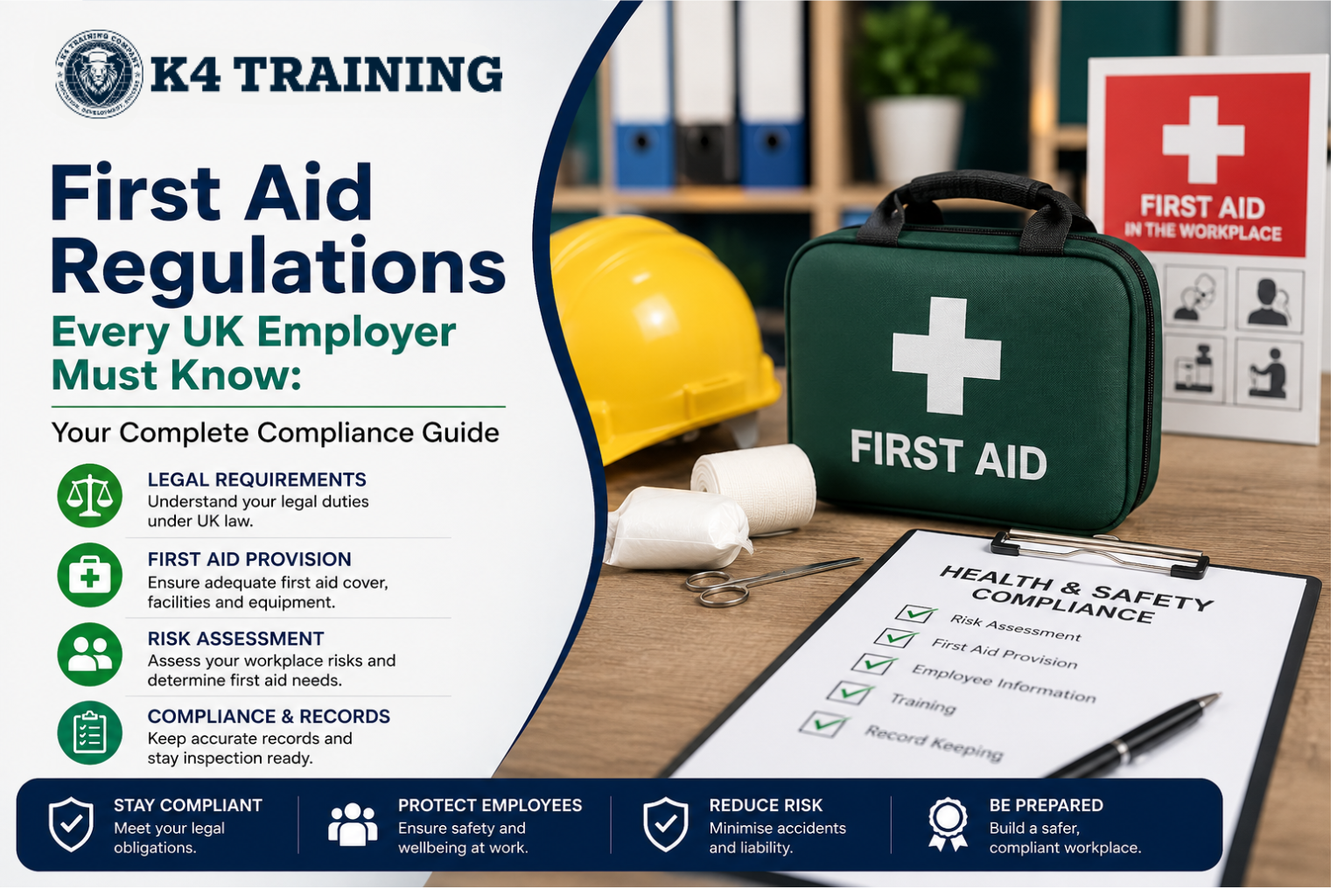
Here’s a fact that surprises most business owners the first time they hear it: the law governing workplace first aid doesn’t care how many people you employ. A five-person accountancy firm and a five-hundred-person distribution centre answer to the same piece of legislation, the Health and Safety (First-Aid) Regulations 1981. What changes isn’t whether the law applies to you. It’s what compliance looks like once you actually assess your risks.
If you run a business in the UK, you carry a legal duty to provide adequate first aid arrangements for your employees. Get this wrong, and the consequences range from an enforcement notice to a genuinely preventable tragedy. We’ll take you through exactly what the regulations require, in plain terms.
The Legal Framework, in Brief
The 1981 Regulations remain the cornerstone of workplace first aid law in Britain, and they apply to every workplace, including businesses with fewer than five staff and the self-employed. Two provisions matter most in practice. Regulation 3 requires that any first-aider you appoint holds valid, appropriate training. Regulation 4 requires you to tell your employees what your first aid arrangements actually are, not just have them, but communicate them clearly enough that staff know what to do.
That second point trips up more businesses than you’d expect. A perfectly adequate first aid kit, checked and stocked, does nothing for an employee who has no idea it exists or where it’s kept.
Start With a First Aid Needs Assessment
Before you buy a single plaster or book a single course, the regulations expect you to conduct a needs assessment, a structured look at your workplace that determines what provision is genuinely appropriate. You’ll want to weigh up your workplace hazards, your headcount, your accident history, and how your workforce is distributed (lone workers, remote staff, and travelling employees all raise different questions than a static office team).
The HSE also recommends, as good practice rather than strict law, that you think about mental health first aid needs and about provision for non-employees such as visitors and contractors, even though there’s no statutory duty to cover the public. The assessment is the document everything else in your compliance picture hangs off: it determines your kit contents, your facilities, and how many trained people you need.
Three Things Every Workplace Must Have
Strip the regulations back to their essentials, and three requirements are non-negotiable.
A suitably stocked first aid kit. There’s no legally fixed list of contents; the law simply requires the kit to be “adequate and appropriate” for your assessed risks. Many employers use British Standard BS 8599-1 as a practical benchmark alongside HSE’s suggested contents. What matters more than the list is the habit: check it regularly, replace anything used or expired, and treat an empty kit as a compliance failure, not an oversight.
An appointed person. Even where your needs assessment concludes you don’t require a fully trained first-aider, you still need someone designated to take charge of first aid arrangements, looking after equipment, calling emergency services, and providing basic cover. They don’t need formal first aid training, though many employers send appointed persons on a short emergency course regardless.
Information for employees. Notices, briefings, inductions, whatever form it takes, your staff need to know who the first-aiders are, where the kit lives, and what to do if something happens.
How Many First-Aiders, and at What Level?
This is where judgment matters more than a formula. As general guidance: lower-hazard workplaces such as typical offices usually need at least one EFAW-qualified first-aider. Higher-hazard environments, such as construction, manufacturing, and warehousing, typically warrant FAW-trained cover, and construction sites in particular are expected to have at least one FAW first-aider per team. Once you’re above roughly 50 employees in a higher-risk setting, a rough benchmark of one FAW-trained first-aider per 50 staff is commonly applied, though your own needs assessment should always take precedence over any rule of thumb.
We once assumed, in an earlier stage of advising clients, that a single first-aider covering two floors of an office was self-evidently sufficient because the headcount was modest. It wasn’t that shift patterns meant that the first-aider was frequently the only person in the building during early mornings, and holiday cover left gaps nobody had planned for. It’s a useful reminder that headcount alone rarely tells the whole story; coverage across time and location matters just as much.
Whichever level of training you land on, certificates for both EFAW and FAW run for three years, after which a requalification course, two days for FAW, keeps things current. Annual refreshers, while not compulsory, are widely recommended because practical skills like CPR technique fade measurably without regular practice.
Records, Reporting, and RIDDOR
There’s no blanket legal duty to log every plaster dispensed, but recording first aid incidents is strongly advised as good practice; it’s often the earliest warning sign of a wider workplace hazard nobody’s noticed yet. Separately, under RIDDOR, certain injuries, dangerous occurrences, and work-related diseases must be reported to the HSE and the records kept for three years. Treat your first aid log and your RIDDOR obligations as connected but distinct systems, not the same thing.
What Happens If You Get It Wrong
The HSE won’t necessarily prosecute over a single missed refresher course, but it will act where it finds significant risk, a disregard for established standards, or a pattern of poor compliance. Consequences range from enforcement notices through to fines and prosecution and, more importantly, the very real possibility that a minor injury becomes something far worse because nobody in the building knew what to do. Company directors and managers can be held personally responsible, which makes this one area where “we didn’t think it applied to us” offer no protection at all.
The Gaps We See Most Often
In practice, the same handful of compliance gaps recur across businesses of every size: first aid kits that haven’t been checked in months, no appointed person named anywhere, certificates that quietly lapsed without anyone noticing, no documented needs assessment on file, and perhaps most commonly, employees who genuinely don’t know what the first aid arrangements even are. None of these requires significant investment to fix. They require someone to take ownership of the review.
Where to Go From Here
Think of the 1981 Regulations less as a compliance hurdle and more as scaffolding the structure that holds everything else in place, from your kit contents to your training schedule. Get the needs assessment right, and the rest of the picture tends to fall into line behind it.
If your last formal review predates your current headcount or workplace layout, that’s the natural place to start. It’s also worth pairing your first aid provision with related compliance training, such as our Level 2 Certificate in Spectator Safety for venues managing public events, or our full First Aid at Work Course (3 Days) for higher-risk sites needing FAW-qualified cover. For the underlying legal text, HSE’s own guidance documents INDG214 and L74 remain the definitive reference points.
FAQs
What are the first aid requirements for UK employers?
Under the 1981 Regulations, you must provide adequate equipment, facilities, and personnel, conduct a needs assessment, and inform employees of your arrangements.
Do I legally need a trained first-aider?
Not automatically, if your needs assessment concludes otherwise, an appointed person may suffice. Many workplaces will still need a trained first-aider based on their actual risks.
How many first-aiders do I need?
It depends on your needs assessment. As general guidance: one EFAW-qualified person for lower-risk settings, and FAW-qualified cover often one per 50 staff for higher-risk or larger workplaces.
What must be in a first aid kit?
No fixed legal list of contents must be adequate for your risks. HSE guidance and British Standard BS 8599-1 are commonly used benchmarks. Medicines shouldn’t be stored in the kit.
How long does a certificate last?
Three years for both EFAW and FAW, with requalification required before expiry.
What is a first aid needs assessment?
A structured review of your workplace hazards, headcount, and accident history that determines your first aid provision is the foundation of your entire compliance approach.
Am I required to cover members of the public?
No legal duty exists, though the HSE strongly recommends including non-employees in your planning.
What happens if I don’t comply?
Potential enforcement notices, fines, and prosecution, plus the real risk of a manageable injury becoming serious because no one was prepared.
Does this apply to small businesses?
Yes. The 1981 Regulations apply to every UK workplace, including those with fewer than five employees and the self-employed.
Do I need to keep incident records?
Not for every treatment, but it’s good practice. RIDDOR separately requires certain injuries and incidents to be reported and records kept for three years.