


Blog
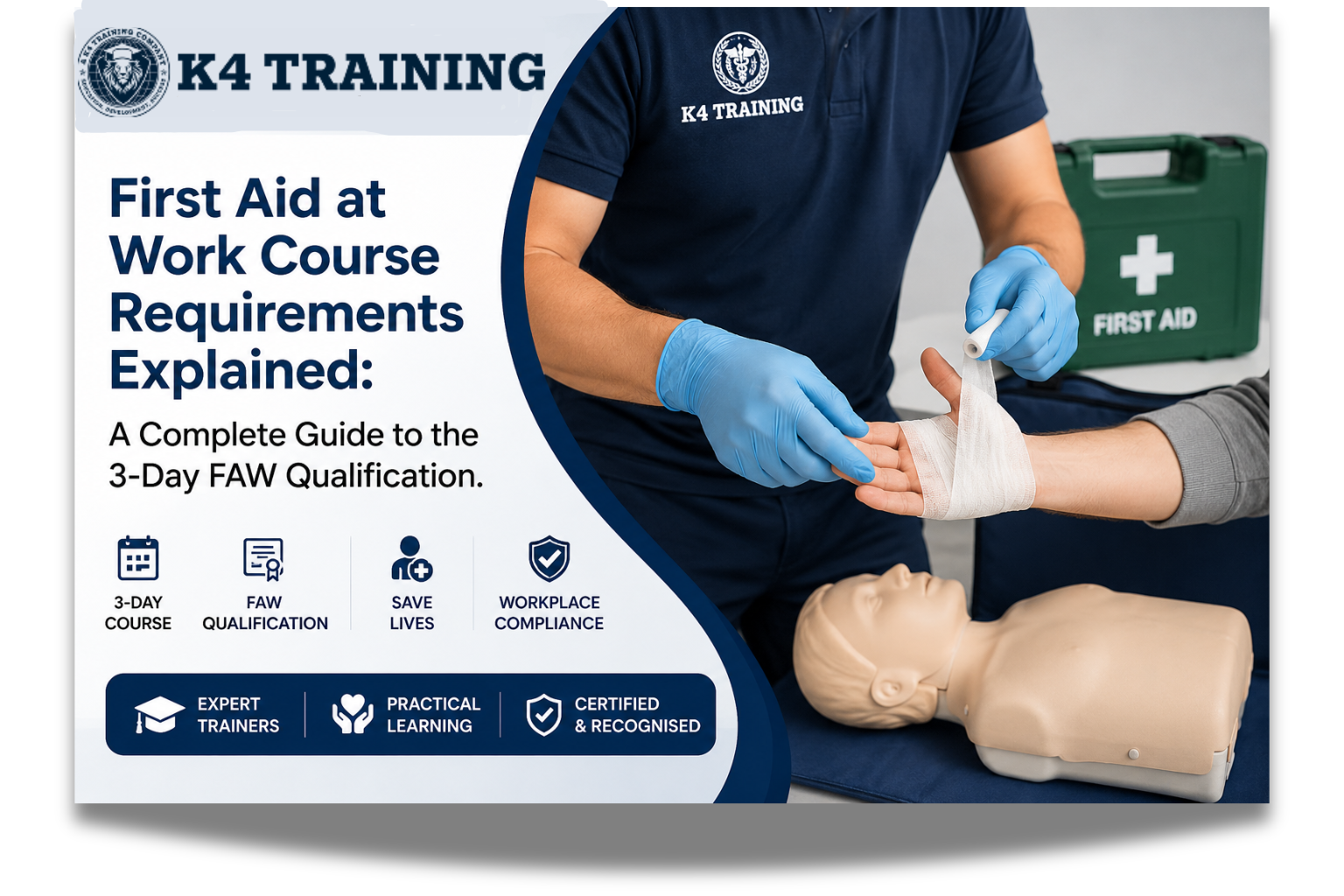
First Aid at Work Course Requirements Explained: A Complete Guide to the 3-Day FAW Qualification.

Imagine a warehouse floor. A pallet shifts, a forklift clips a leg, and for the next four minutes, before the ambulance arrives at the industrial estate. The only medical help available is whoever is standing nearby. That gap, the space between an incident and professional help arriving, is what the First Aid at Work (FAW) course exists to close.
If you’re an employer assessing the need for this qualification. Or an individual who has been informed they’ll be a workplace first aider. You would be wondering:
- What the course involves
- How long does it take
- What the law expects of you
We’ll walk you through all of it.
What Is the First Aid at Work Course, Exactly?
FAW is a regulated Level 3 qualification, built around the syllabus set out in Schedule 1 of the Health and Safety (First-Aid) Regulations 1981. It’s the more substantial of the two main workplace options. The other is Emergency First Aid at Work (EFAW), a single-day course covering the essentials of CPR, choking, bleeding control, and basic incident management.
FAW goes considerably further. You’ll still need it if your first aid needs assessment flags your workplace as higher risk: construction, manufacturing, warehousing, agriculture, or any environment where machinery, height, or hazardous substances raise the stakes. Larger organisations with more employees, more shifts, and more variables also tend to land here, even in office-based settings, once the numbers get big enough.
There’s no HSE-mandated headcount formula that tells you “you need FAW at exactly 200 staff.” The regulations deliberately avoid that kind of blanket rule, because a five-person scaffolding crew and a five-hundred-person call centre carry entirely different risks. What the law does require is that you actually sit down and assess your workplace, then choose training proportionate to what you find.
How Long Does the Course Take, and What Does the Schedule Look Like?
FAW runs across three days, with a minimum of 18 contact hours, six hours a day, breaks excluded. Providers can deliver it on three consecutive days or spread it over a longer window, but the whole thing has to wrap up within 10 weeks of the first session. Many training providers, including us at First Aid At Work Course (3 Days), also offer blended formats: a portion of theory completed online beforehand, followed by concentrated practical days in the classroom.
That practical component isn’t a formality. You’ll spend real time on the floor doing CPR on a manikin, practising the recovery position, and working through simulated scenarios, because muscle memory under pressure is the entire point of the qualification.
Entry requirements are simple. You need to be at least 16, and you don’t need any prior first aid knowledge. What you do need is the physical capability to perform the practical assessments kneeling, working at floor level, and sustaining chest compressions for a realistic duration.
What’s Actually in the Syllabus?
The three days typically break down like this:
Day one covers the core life-saving fundamentals:
- The role and legal responsibilities of a first aider
- How to assess a scene safely
- CPR
- Managing an unresponsive casualty
- Seizures
- Choking
- The use of an automated external defibrillator (AED)
Day two moves into injury management:
- Bleeding and shock
- Minor wounds
- Burns and scalds
- Fractures
- Joint injuries
- The early handling of suspected spinal injuries
Day three brings it together with medical emergencies and assessment:
- Chest injuries
- Anaphylaxis
- Poisoning
And recognising major illnesses such as:
- Heart attacks
- Strokes
- Asthma attacks
- Diabetic emergencies
Plus how to record and report what happened.
Throughout, you’re assessed continuously and formally through 6 practical assessments and 2 multiple-choice theory papers. It is possible to fail. If you don’t demonstrate the required competence, the certificate isn’t issued until you do.
One thing worth knowing before you book: the industry itself doesn’t stand still. St John Ambulance announced that from May 2026, its FAW courses will incorporate training on controlling catastrophic bleeding using nationally agreed techniques, a direct response to growing evidence that early haemorrhage control saves lives that CPR alone cannot. It’s a reminder that a “standard” course today looks meaningfully different from one delivered even five years ago, and it’s worth asking any provider what’s changed in their syllabus recently.
Certification, Validity, and Keeping Skills Sharp
Your FAW certificate is valid for three years from the day you complete the course. Before it expires, you’ll need a two-day requalification course (12 contact hours) rather than the full three-day version again. Miss that window and lapse the certificate entirely, though, and most providers will require the complete initial course from scratch.
The HSE also recommends annual refresher training, even though it isn’t a legal requirement. This is one of those areas where the letter of the law and good practice quietly diverge. A skill like chest compressions, performed at the correct depth and rate, degrades faster than most people expect without regular practice, which is why an annual top-up, even an informal one, genuinely matters.
Choosing a Training Provider You Can Trust
Here’s something that catches a lot of employers out: the HSE hasn’t approved first aid training providers since 2013. There’s no official government stamp of approval to look for. Instead, the responsibility sits with you, the employer, to judge whether a provider is competent.
The HSE’s own guidance for selecting a provider points to a few concrete markers: trainers who hold current first aid and teaching qualifications, a tutor-to-candidate ratio no worse than 1:12, a syllabus that genuinely follows Schedule 1, and a qualification recognised by an Ofqual-regulated awarding body. Ask, too, about complaints handling and quality assurance. A provider with nothing to say here is worth a second look.
We’ll admit that early in our own training history, we underestimated how much candidates valued seeing a provider’s quality assurance documentation upfront rather than after signing up. It’s a small thing, but transparency at that stage tends to predict transparency everywhere else.
Red flags are usually easy to spot once you know to look:
- Trainers who can’t produce their own current certification
- Group sizes well beyond 12
- A course that promises full competence in a fraction of the required hours
If a provider is cagey about hours, ratios, or assessment structure, treat that as your answer.
What Should You Budget For?
A three-day FAW course costs £220 to £349, depending on location, group size, and in-house or training centre training. The cost normally comprises teaching, the course handbook, and manikins and AED trainers. Travel, overnight stays for multi-day courses away from base, and staff cover during training should be considered.
Bringing It Together
The FAW course exists because the four minutes between an incident and the arrival of paramedics are often the four minutes that matter most. Getting the qualification right the right course, the right provider, the right refresher schedule isn’t paperwork for its own sake. It’s the difference between a workplace where someone knows exactly what to do and one where everyone is guessing.
If you haven’t reviewed your first aid provision recently, a proper needs assessment is the natural starting point, and it pairs well with related training such as our SIA Door Supervisor Refresher + First Aid course for venues managing both security and first aid duties under one roof.
FAQs
How long is a First Aid at Work course?
Three days, with a minimum of 18 contact hours (six hours per day, excluding breaks). It can be spread out, but it must finish within 10 weeks of starting.
What’s the difference between FAW and EFAW?
FAW is the full three-day, 18-hour qualification for higher-risk workplaces. EFAW is a one-day, six-hour course for lower-risk settings. Your needs assessment determines which applies.
How long does an FAW certificate last?
Three years from completion, renewable through a two-day requalification course. Annual refreshers are strongly recommended, though not legally mandatory.
What does the course actually cover?
CPR and AED use, unconsciousness, choking, bleeding, shock, fractures, burns, eye injuries, anaphylaxis, chest injuries, poisoning, and recognition of major illnesses like stroke and heart attack.
Can you fail the course?
Yes. Certification depends on passing six practical assessments and two theory papers.
Does the HSE approve training providers?
No, not since 2013. Employers must judge provider competence themselves, using HSE guidance on qualified trainers, ratios, and quality assurance.
What are the entry requirements?
Minimum age 16, no prior knowledge needed, and physical capability to complete practical assessments, including floor-level CPR.
How much does it cost?
Typically £220–£349 for the full three-day course, covering instruction, materials, and equipment use.
Can the course be completed online?
Not entirely, the practical component is non-negotiable. Blended formats combining e-learning with face-to-face practical days are available from many providers.