


Blog
FREC 3 Course vs. Standard First Aid: Why the Higher Qualification Matters for Your Career

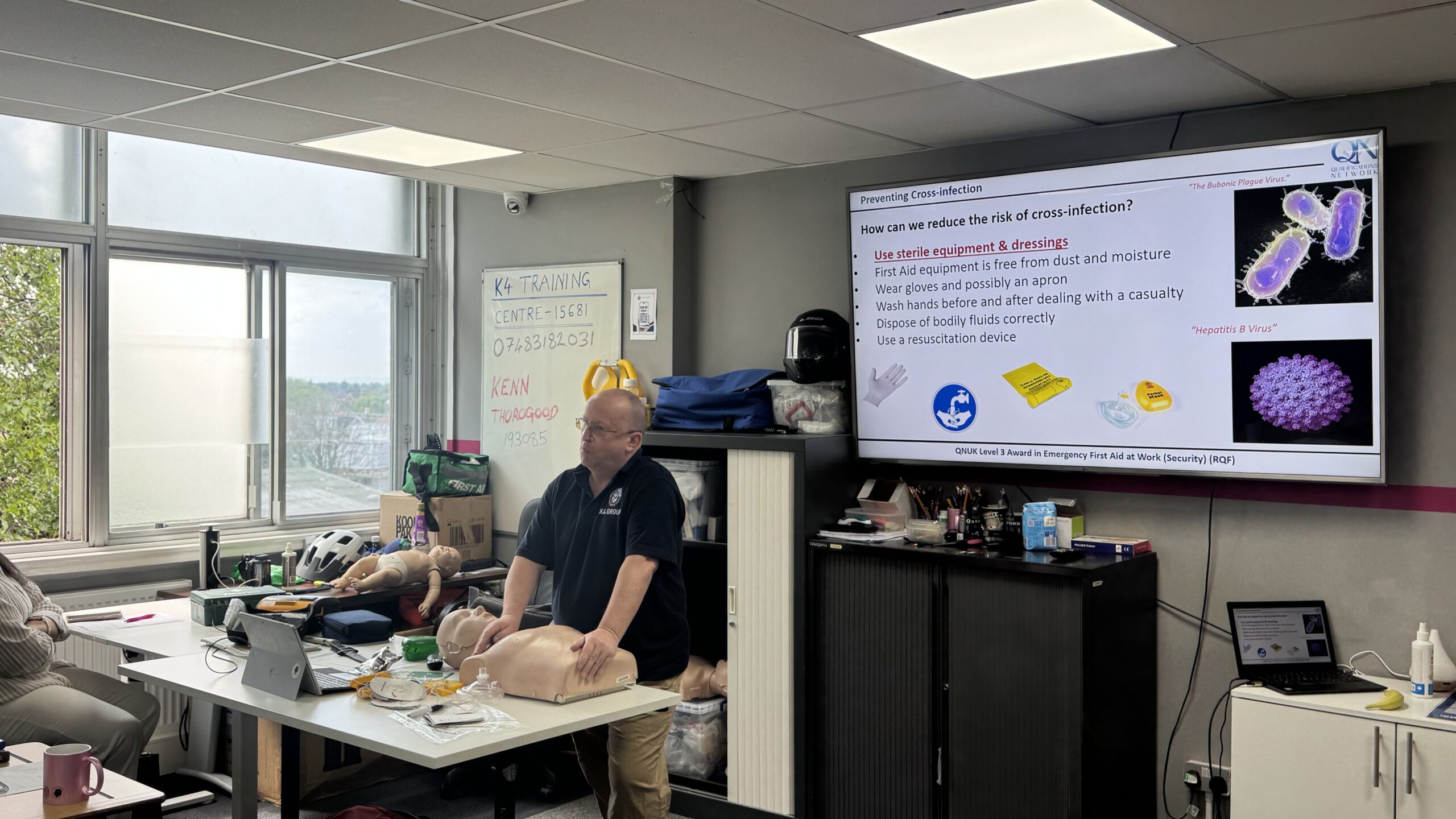
UK employers in security, events and high-risk fields now seek responders with advanced skills, not just CPR. The FREC 3 course meets this demand, making it a top pre-hospital care qualification.
This guide compares standard First Aid at Work training with the FREC level 3 qualification and explains why the higher award increasingly matters for career progression. It also explores what learners should expect from a first response emergency care level 3 course, how employers view it and why searches for “FREC 3 course near me” continue to rise.
Why Standard First Aid No Longer Covers Every Role
Standard First Aid at Work training was built for low-risk environments. Offices. Retail spaces. Warehouses with predictable hazards.
But modern frontline work looks different.
Door supervisors now manage crowded nightlife districts shaped by alcohol, drugs and rising violence. Event teams cover festivals with tens of thousands of attendees. Close protection officers operate in fast-moving public settings where help may be minutes away.
According to the UK Health Security Agency and data published by the NHS, traumatic injuries linked to violence and crowd incidents have put pressure on first responders in public spaces. Meanwhile, the Qualsafe Awards framework expanded pre-hospital qualifications specifically to bridge the gap between workplace first aid and emergency medical response, which matters.
A standard first aid course teaches someone how to react. A FREC 3 qualification trains someone how to assess, stabilise and manage a casualty until advanced care arrives.
The difference is similar to carrying a household fire extinguisher versus operating with a firefighter’s breathing apparatus. Both serve a purpose. Only one prepares someone for sustained emergencies.
The “Near Me” Search Boom And What It Means
Searches for “FREC level 3 course near me” and “FREC 3 near me” have surged because many learners already understand one thing: employers increasingly list FREC as a hiring advantage, but location still matters.
Unlike some online first aid certificates, a FREC 3 course near me requires practical assessments in person. Learners complete scenarios involving trauma care, airway management, CPR, patient assessment and emergency equipment under instructor supervision.
Many providers also require around 10 hours of pre-course study before attendance, which catches some learners off guard.
Some contractors once assumed they could “turn up and pass” using only previous first aid experience. In practice, anatomy, respiratory assessment and patient management sections demand preparation. The strongest candidates usually arrive having already reviewed basic physiology and incident procedures.
Standard First Aid vs. FREC 3
| Feature | Standard First Aid at Work | FREC 3 Course |
| Qualification Level | Level 2 | Level 3 |
| Designed For | Offices, retail, low-risk workplaces | Security, events, ambulance support, police, fire |
| Pre-course Study | Usually none | Approx. 10 hours recommended |
| Trauma Training | Basic | Advanced |
| Airway Management | Limited | Included |
| Catastrophic Bleeding Control | Minimal | Extensive |
| Oxygen Therapy | No | Yes |
| AED & Patient Monitoring | Basic | Advanced practical use |
| Assessments | Limited practical tests | Multiple practical assessments + theory papers |
| Physical Demand | Low | Moderate to high |
| Validity | 3 years | 3 years |
| Career Progression | Limited | Route into higher pre-hospital qualifications |
Not every workplace requires advanced pre-hospital care training, but several industries increasingly expect it.
Who Needs a FREC Level 3 Qualification?
Not every workplace requires advanced pre-hospital care training, but several industries increasingly expect it.
Security and Door Supervision
Violence-related injuries rarely unfold neatly. Knife wounds, head trauma, intoxication, crowd crushes and unconscious casualties demand more than bandages and reassurance.
Many security employers now prefer applicants holding a FREC level 3 qualification because it demonstrates readiness for high-pressure incidents.
A recent scan of UK event medic and security job listings showed FREC appearing regularly as either “required” or “preferred,” while standard First Aid at Work often appeared only as a minimum baseline.
Event Medical Teams
Festivals and sporting events create unpredictable environments: heat exhaustion, substance misuse, fractures, panic attacks, dehydration and cardiac incidents can occur within minutes of each other.
A CQC-registered ambulance provider supporting large public events reported that responders with FREC training adapted faster during multi-casualty incidents because they already understood patient assessment structures and communication protocols.
Police, Fire, and High-Risk Industries
Police officers and firefighters are often first on scene long before ambulance crews arrive.
Agricultural workers, power station teams and industrial responders also benefit because remote or hazardous environments delay advanced medical access.
In those settings, the first responder becomes the bridge between injury and survival.
The Investment vs. The Career Payoff
A FREC 3 course demands more commitment than a standard first aid certificate.
Costs commonly sit around £475, including VAT, depending on provider and location. Learners must complete theory work, practical scenarios, anatomy modules and formal assessments, but employers recognise the difference.
The qualification awarded is typically the Qualsafe Level 3 Award in First Response Emergency Care (RQF), regulated through recognised awarding standards, Qualifications Network.
For candidates aiming to work in:
- Event medical services
- Patient transport
- Door supervision
- Close protection
- Ambulance support
- High-risk industrial response
…the qualification often shifts applications into a stronger category.
That is the commercial reality behind searches for “FREC 3 course near me.” The qualification is not simply educational; it is employability-focused.
Higher Qualification Does Not Mean “Overqualified”
A common assumption still circulates in some sectors: advanced medical training is unnecessary unless someone plans to become a paramedic. That view is fading.
Modern employers increasingly value layered capability. A security officer who can safely manage a trauma casualty adds operational resilience. An event responder with advanced assessment training reduces pressure on stretched ambulance services.
The qualification does not replace paramedics. It strengthens the critical minutes before paramedics arrive.
Research from trauma response studies published through the Resuscitation Council UK consistently shows that early intervention quality influences survival outcomes in cardiac arrest and severe trauma cases.
In other words, those first minutes matter more than many organisations once believed.
From FREC 3 to Paramedic Pathways
The FREC Level 3 award is not a dead end. For many learners, it becomes the first serious step into pre-hospital care careers. The progression commonly looks like this:
FREC 3 → FREC 4 → Higher pre-hospital qualifications → Paramedic pathways
FREC 4 introduces significantly deeper clinical knowledge and contextualised learning. Some learners later progress toward HCPC-aligned routes into ambulance services and healthcare support roles. That progression pathway gives the FREC 3 qualification long-term value beyond immediate employment.
Why the Higher Qualification Matters
Standard first aid is important in low-risk settings, but high-risk roles require more advanced skills. The FREC 3 course is now essential for security, event and pre-hospital professionals. It builds calm, decisive responders ready for emergencies.
Book early, as pre-course study is required and spaces fill quickly.
FAQs: What Learners Usually Ask Before Booking
Q1.Does someone need experience before taking a FREC 3 course?
Previous first aid knowledge is strongly recommended. Learners without any emergency care background often struggle with anatomy, patient assessment and practical scenarios.
Q2.How long does the qualification remain valid?
The qualification remains valid for three years. After that period, learners usually complete a three-day requalification programme.
Q3.Is the course physically demanding?
Yes. Practical assessments involve kneeling, lifting, recovery positioning, CPR and simulated emergency scenarios.
Q4.Can learners take only the requalification course?
Yes, if they already hold an eligible and valid FREC 3 or FPOS qualification.
Q5.Is there online learning involved?
Most providers include pre-course study modules or workbooks before practical attendance days begin.