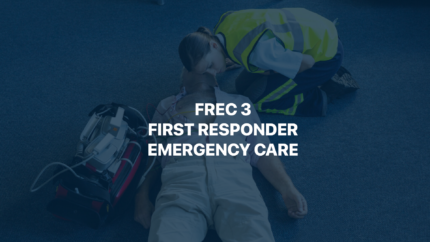
FREC 3 (First Responder Emergency Care)
FREC 3 (First Responder Emergency Care)

No prior medical background needed. Just the willingness to learn skills that could genuinely save someone’s life.
This course is designed for people who could realistically be first at the scene of a serious incident:
- Door supervisors, close protection operatives and security guards
- Event medical staff and stewards
- Police officers, firefighters and community first responders
- Military personnel
- Anyone working in power generation, agriculture, manufacturing, or other high-risk industries
Because this is a more advanced qualification than a standard First Aid at Work course, previous first aid knowledge is genuinely useful going in, though it’s not a formal requirement. You’ll need to be at least 17 years old on the first day of training.
So, what is FREC 3? In plain terms, it’s an Ofqual-regulated qualification for people who could be first on scene at a medical emergency, trauma, cardiac arrest, or serious injury before paramedics arrive. FREC3 training goes further than a standard first aid course, covering advanced airway management, catastrophic bleeding control and structured emergency trauma care, all built around genuine emergency medical response training rather than theory alone.
FREC 3 asks a bit more of you upfront than a standard first aid course and that’s by design.
- Around 18 hours of pre-course study, including workbook activities and access to online learning materials
- We recommend leaving at least three weeks between booking and your start date to fit this in properly
- A basic grasp of anatomy and physiology helps, but you don’t need it; walking in the course builds it as you go
- Expect a genuinely hands-on, physically active five days
The course covers a huge amount of ground, structured around how a first responder actually works a scene.
Understanding the first responder role
You’ll start with the fundamentals: assessing incidents safely, prioritising actions under pressure, communicating clearly and working alongside the emergency services rather than getting in their way.
Patient assessment and emergency care
This is where the technical skills live: airway assessment and management, recognising life-threatening versus non-life-threatening conditions, safe AED use, administering emergency oxygen, adult and child CPR, managing breathing difficulties, responding to anaphylaxis and spotting the signs of major illness.
Trauma and serious injuries
The other half of the course focuses on trauma: controlling catastrophic bleeding, managing chest injuries, treating wounds and eye injuries, dealing with burns and scalds, responding to poisoning and handling head, spinal and musculoskeletal injuries plus convulsions, seizures and the effects of extreme environmental exposure.
Complete the course and you’ll hold a FREC3 course qualification, officially the Qualsafe Level 3 Award in First Response Emergency Care (RQF), Ofqual-regulated and clinically endorsed by the Royal College of Surgeons of Edinburgh. It’s recognised across security, emergency and medical sectors, not just a certificate that sits in a drawer.
It’s also a genuine stepping stone. FREC 3 can count towards progression to the Level 4 Certificate in First Response Emergency Care, a step some learners take on the way toward paramedic registration, which itself sits with the HCPC. Completing the course may also open up opportunities with K4 Medical Services, including event medical cover and patient transport work, depending on operational need and suitability.
- A five-day FREC 3 course, the standard, industry-recognised format for this qualification
- Practical, scenario-heavy training running throughout, not confined to the final day
- Assessed continuously, so there’s no single high-stakes exam for the practical elements
- Comfortable, practical clothing recommended; you’ll be moving, kneeling and getting hands-on throughout
- If you’re weighing up FREC 3 cost against other providers, check what’s actually included; ours covers materials, assessment and certification with nothing added on afterwards
Our FREC 3 course London sessions run from our training venue in small groups, with assessment woven through the five days rather than saved for the end. Searching for FREC course London, or a FREC 3 training near me if you’re based in or around the capital? This is where you’ll train no long trek out of the city needed. If you’ve been hunting for a FREC 3 course near me specifically, our London venue is the closest option for most of the city.
vary in price depending on group size, delivery format and whether you’re booking as an individual or through your employer. Our FREC 3 qualification is priced to reflect a genuine five-day, FREC level 3 programme, not a stripped-down version. So, how much is a FREC 3 course? It depends on your circumstances, but every FREC 3 course price we quote includes materials, assessment and certification, with nothing hidden or added on afterwards. Get in touch with our team for an accurate quote.
FREC 3 (First Response Emergency Care Level 3) is an Ofqual-regulated qualification for people who could be first on scene at a medical emergency. It goes beyond standard first aid, covering advanced trauma care, airway management and emergency response skills.
It’s designed for security personnel, event medics, police officers, firefighters, military personnel and anyone working in high-risk environments where they might need to respond to a serious medical emergency before help arrives.
There’s no formal requirement, but previous first aid knowledge is strongly recommended. FREC 3 is a more advanced qualification and you’ll get more out of it with some grounding already in place.
Pricing depends on group size and delivery format; get in touch with our team for an accurate quote. Every FREC 3 course cost we quote covers materials, assessment and certification, with nothing hidden or added afterwards.
No. FREC 3 first aid training goes well beyond a standard first aid course, covering advanced trauma care, airway management and prehospital emergency skills for people who could genuinely be first on scene at a serious incident.
Assessment runs throughout the course: six practical skills tests, three multiple-choice theory papers and one invigilated anatomy and physiology exam.
Yes. It’s a hands-on, scenario-based qualification with real physical activity involved: CPR practice, casualty handling and equipment use throughout the five days.
Successful learners receive a Qualsafe FREC level 3 Award in First Response Emergency Care (RQF) e-Certificate, valid for three years from the date of issue.
No reviews yet for this course.

 Course
 Course
 Course
 Course
 Course
 Course