


Blog
Why Every Workplace Needs First Aiders (Legal & Human Case)

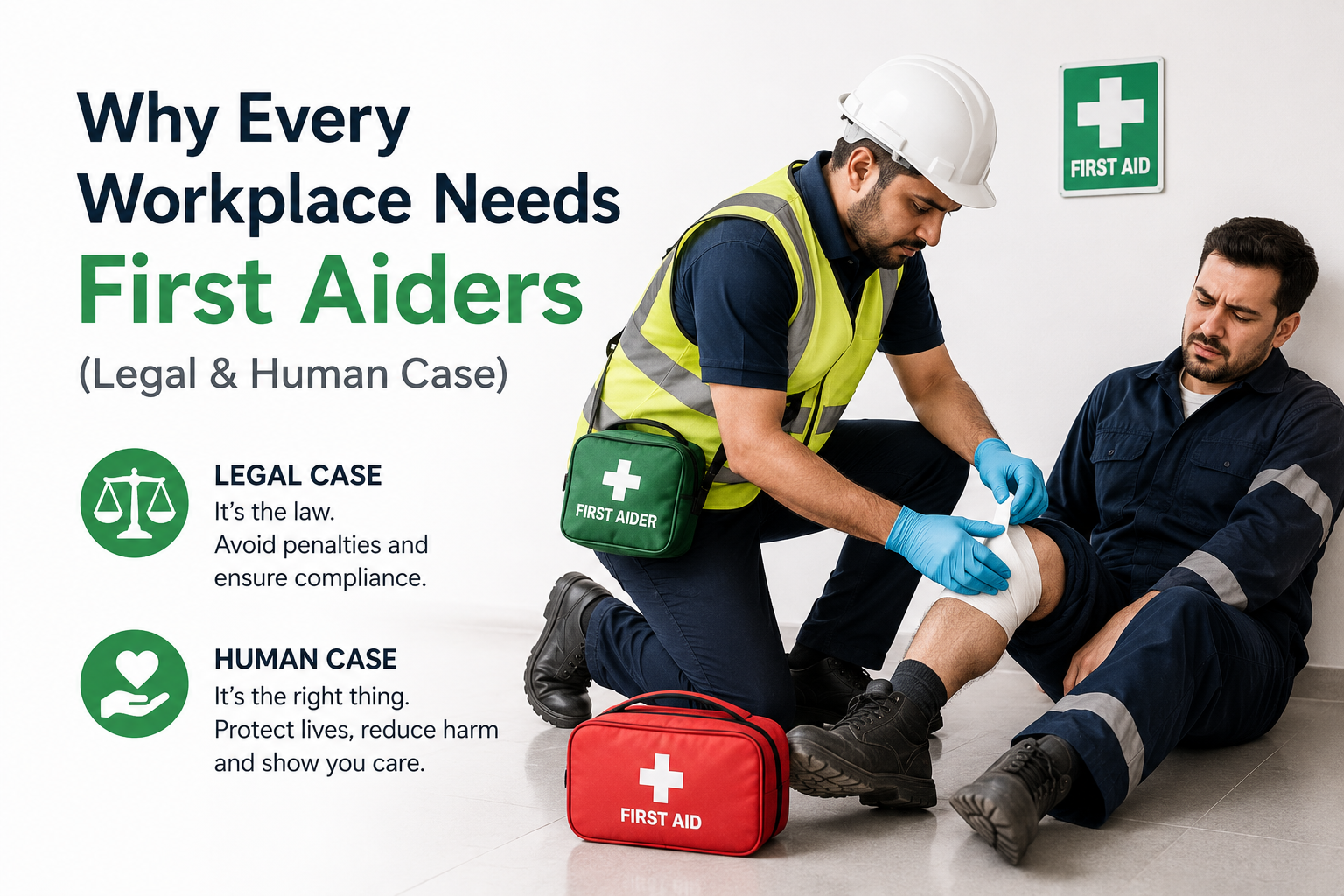
Imagine the office kitchen at 11 am on a Tuesday. Sandwich-choking occurs. Someone clutches their chest. The only thing standing between a scare and a tragedy is who is close. Whether they know what to do in the first sixty seconds.
British employers experience that trouble more often. British work-related incidents killed 138 individuals in 2023/24, while 40.1 million working days were lost to illness and injury. Behind those numbers is a harsher truth: University of Manchester research indicated that first aid before an ambulance could have avoided many injury-related deaths. The gap between “someone called 999” and “someone acted” is often the gap between a full recovery and a funeral.
Many businesses still consider first aid as an afterthought, a green box on the wall refilled once a year with no one knowing who has the key. A third of St John Ambulance personnel feel nervous on days without a skilled first aider, according to a 2025 study. That fear shows that people instinctively know crisis competence isn’t a luxury.
Inspectors don’t require qualified first aiders. They are a legal obligation, a financial safety, and, when it counts, the difference between a colleague going home that night.
The Legal Case
Under the Health and Safety (First-Aid) Regulations 1981, you have to provide “adequate and appropriate” first aid equipment, facilities and personnel. This duty applies to organisations with fewer than five employees and to the self-employed; there is no size threshold below which it disappears.
This means that you must do a documented first aid needs assessment, ensure that employees receive prompt attention if they are injured or become ill at work, keep appropriate equipment, appoint someone to be responsible for first aid arrangements and make sure that first aiders have a valid certificate of competence from an organisation approved by HSE where the first aid needs assessment identifies this as necessary. The assessment itself should take into account the nature of your business, the size of your workforce, the distance from emergency services, accident history, shift patterns, and any staff with specific health needs. A warehouse and a design studio will arrive at very different responses.
Not doing this is not a paperwork risk; it’s a legal risk.” Non-compliance can lead to HSE enforcement action, civil claims when an injury is aggravated due to lack of assistance, and reputational harm, which will last longer than any consequence. Employers have been prosecuted for not offering first aid training even to staff who only drive for work, a sign of how widely the requirement is interpreted.
Under the Health and Safety (First-Aid) Regulations 1981, you have to provide “adequate and appropriate” first aid equipment, facilities and personnel. This duty applies to organisations with fewer than five employees and to the self-employed; there is no size threshold below which it disappears.
This means that you must do a documented first aid needs assessment, ensure that employees receive prompt attention if they are injured or become ill at work, keep appropriate equipment, appoint someone to be responsible for first aid arrangements and make sure that first aiders have a valid certificate of competence from an organisation approved by HSE where the first aid needs assessment identifies this as necessary. The assessment itself should take into account the nature of your business, the size of your workforce, the distance from emergency services, accident history, shift patterns, and any staff with specific health needs. A warehouse and a design studio will arrive at very different responses.
Not doing this is not a paperwork risk; it’s a legal risk.” Non-compliance can lead to HSE enforcement action, civil claims when an injury is aggravated due to lack of assistance, and reputational harm, which will last longer than any consequence. Employers have been prosecuted for not offering first aid training even to staff who only drive for work, a sign of how widely the requirement is interpreted.
The Human Case: Why First Aiders Save Lives
Think of the body in cardiac arrest like a candle in the wind; the flame doesn’t go out all at once, but every gust of delay weakens it further. Survival chances fall by roughly 10% for every minute CPR or defibrillation is delayed. An ambulance racing through traffic simply cannot beat the colleague already standing three metres away.
Workplaces with trained first aiders consistently report less severe outcomes when accidents happen. One widely reported case from Sellafield involved a worker whose first aid training helped save a colleague experiencing cardiac arrest, a category of emergency where survival without rapid intervention is grim. These aren’t abstract statistics; they’re colleagues who went home instead of becoming one.
There’s a quieter cost too. A third of employees report feeling anxious when no trained first aider is present. As Julie Riggs, Director of Education at the British Safety Council, has said, a rapid response can save lives, limit the severity of injuries, and give employees confidence that their wellbeing genuinely matters.
First aid is also expanding beyond cuts and burns. Mental health issues now account for around half of all working days lost to ill health, and it isn’t yet a legal requirement to train mental health first aiders, but treating it as optional is starting to look like the mistake employers once made with physical first aid, before regulation caught up. We’ll admit this is ground we once underestimated ourselves, treating mental health support as a wellbeing extra rather than a first-response skill. That view hasn’t aged well.
The Business Case
Good safety training is a good investment. It reduces incident rates and helps cut workers’ compensation claims and insurance premiums, and the disruption that follows every big accident, the way regular maintenance quietly prevents the one expensive failure. Physical safety at work is tied to earlier reporting of near misses and higher trust in leadership, which has a direct impact on retention and recruiting. And training tends to hone hazard awareness in the general sense, not just emergency response, so you have more eyes monitoring for the spill on the floor or the frayed wire. None of this has to be advertised individually; it is part of the way your organisation is known.
Understanding First Aid at Work (FAW) Training
The First Aid at Work Course (3 Days) builds real depth. The first two days cover:
- A first aider’s responsibilities
- Assessing an incident
- Managing an unresponsive casualty through CPR and recovery position
- Handling choking, bleeding, shock, and burns.
Day three adds:
- Heat exhaustion
- Diabetic emergencies
- Asthma and severe allergic reactions
- Stroke recognition
- Fractures
- Spinal and chest injuries
- Heart attacks
Certificates run for three years, with the HSE recommending annual refreshers in between; CPR skills fade faster than people expect. Before expiry, first aiders need a requalification course; once lapsed, they’re no longer considered competent to act. If a certificate is close to running out, an SIA Door Supervisor Refresher + First Aid or a FREC 3 Requalification may fit, depending on sector.
| Factor | EFAW (1 Day) | FAW (3 Days) |
| Best for | Lower-risk workplaces | Higher-risk workplaces |
| Covers | Emergency basics | Emergency care plus specific injuries |
| Typically required in | Smaller teams, fewer hazards | Manufacturing, construction, high-risk sites |
How Many First Aiders Do You Need?
| Workplace Size | Minimum Guidance |
| Fewer than 5 employees (low-risk) | One appointed person; formal training not mandatory |
| 5–50 employees | At least one trained first aider |
| 50+ employees (low-risk) | At least one FAW-trained first aider per 100 staff |
| 50+ employees (high-risk) | At least one FAW-trained first aider per 50 staff |
These are floors, not targets. Shift patterns, remote workers, multiple sites, and holiday cover usually push your real requirement higher.
Putting Provision in Place
First, analyse needs (the HSE’s INDG214 checklist is a good starting point), then calculate numbers and course type. Select a supplier whose courses exceed HSE standards. Not all certificates are equal. A Train The Trainer certification is worth considering if you’d prefer to train someone in-house to offer continuous sessions rather than re-book external courses annually. Once workers are educated, preserve certificates, treatment logs, and accident records in a visible area, make sure personnel know their first aiders, and update the arrangement anytime your workplace changes.
Common Employer Questions
“What if a first aider gets it wrong?”
Unlikely to bring legal action, first aiders are expected to act in good faith and without recklessness, and employers’ liability insurance typically covers this.
“We’re a small office; do we need this?”
Yes. Fainting, choking, and cardiac events don’t check headcount first, and the regulations don’t exempt low-risk sites from having a plan.
“Isn’t an appointed person enough?”
They can take charge and call for help but aren’t trained to intervene clinically. The HSE considers this sufficient only where risk is genuinely minimal.
“What does it cost?”
Prices vary by provider, but set against the estimated £22.9 billion workplace injury and ill health costs the UK economy annually, the individual outlay is modest.
Worth Being Honest About
Training isn’t a guarantee, and no course makes every employee flawless under pressure the first time it matters. Skills fade without practice, which is why refreshers exist. And first aid doesn’t replace proper risk assessment; it’s the layer that catches what prevention didn’t. Treating it as your entire safety strategy would be a mistake.
FAQs
Is it a legal requirement to have a first aider in the workplace?
Yes. The Health and Safety (First-Aid) Regulations 1981 require you to have sufficient and suitable first aid equipment, facilities and trained staff. This can be either a trained first aider or an appointed person, depending on your first aid needs assessment.
How many first aiders are required in the workplace?
It’s not a set number; it’s based on the size of your workplace, risk level and your circumstances. The number of trained first aiders required depends on the size and risk level of the workplace, and is as follows: 5-50 employees, at least one trained first aider; more than 50 employees, or higher risk, more first aiders. The number for your business should be determined by your needs assessment.
What is the difference between EFAW and FAW training?
Emergency First Aid at Work (EFAW) is a one-day course in basic emergency skills. First Aid at Work (FAW) is a three-day course covering all the topics of EFAW and the specific injuries and illnesses, including fractures, spinal injuries, heart attacks and strokes. FAW is generally more suitable for workplaces with a higher risk.
How long does a First Aid at Work certificate last?
An FAW certificate lasts for 3 years. The HSE advises refresher training to be carried out annually to maintain skills. Before the certificate expires, first aiders need to complete a requalification course. Once it lapses, they’re no longer considered competent to act in the role.
Can a first aider be sued for providing first aid?
It’s highly unlikely. First aiders are protected where they act in good faith, not recklessly and within the scope of their training. Employers’ liability insurance will normally cover trained first aiders working in the workplace, and the HSE is quite clear that it would be extremely unusual to take action against a first aider who acted properly.
Do you need mental health first aiders too?
It is not yet mandatory in the UK, but it is becoming considered best practice. Mental health problems cost approximately 50% of all working days lost due to ill health, and it is clear that there is a growing momentum to make mental health first aid comparable to physical first aid, including from organisations such as St John Ambulance.
What happens if a first aider's certificate expires?
After it expires, the person is no longer legally qualified to serve as a workplace first aider. They will have to take a requalification course or the entire course if it has been a long time since their last one to return to the position.
How do you conduct a first aid needs assessment?
If you are familiar with your premises, teams, hazards, and working patterns, you can do one yourself. Look at workplace hazards, employee numbers and shift patterns, layout and distance from emergency services, past accident records, and any staff with particular health needs, then document it as evidence of compliance.