


Blog
Door Supervisor Licence Requirements Explained: Your Complete 2026 Guide

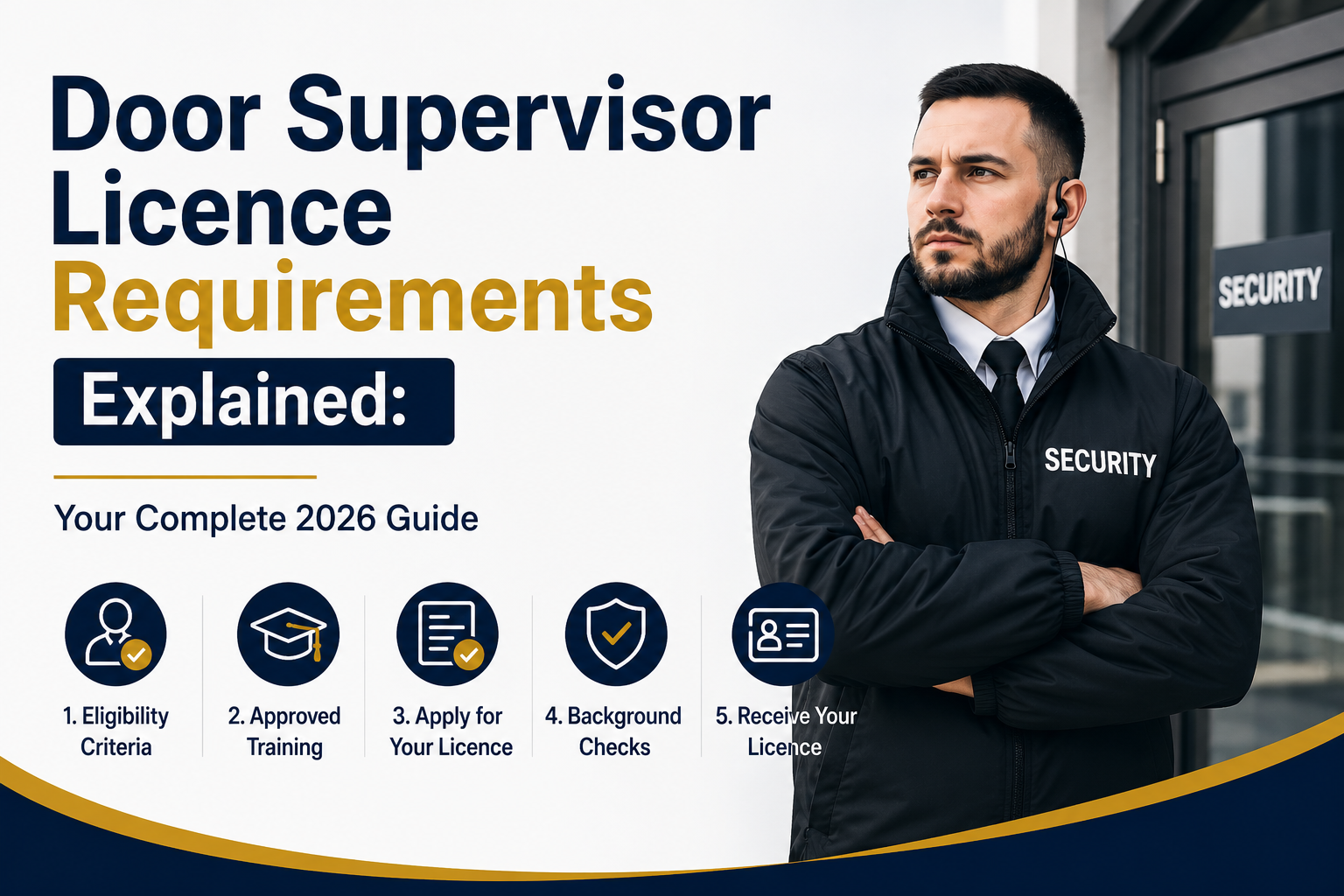
Picture the queue outside a busy Saturday-night venue: a steady line of people, a doorway that needs reading in seconds, and one person standing between chaos and calm. That’s the job you’re signing up for as a door supervisor, and before you ever take that spot, the law says you need to prove you’re ready for it.
If you’re weighing up a career in the UK security industry, you’ve probably already heard the term “SIA licence” thrown around a dozen times. What you might not have is a clear picture of what actually gets you there: the eligibility rules, the training you’re required to complete, what it costs, and what changes once your badge is in hand. We put this guide together to walk you through it properly, in the order you’ll actually need it.
What Is an SIA Door Supervisor Licence?
The Security Industry Authority (SIA) regulates the UK’s private security industry, and a door supervisor licence is your legal permission slip to work the door whether you’re employed directly by a venue or supplied through a security contractor. It confirms you’ve cleared identity checks, passed a criminal record screening, and completed approved training.
Your licence lasts three years. Miss the renewal window, and you’re not legally allowed to keep working the role, full stop.
Who Actually Needs One?
The problem is people are confused because it’s not the job that determines if you have to have a licence; it’s what you do on shift. If you have any of the following jobs, you’re protected:
- Controlling entry to licensed premises such as pubs, bars, nightclubs, or ticketed events
- Assessing whether someone should be allowed in
- Managing queues or defusing conflict at the door
- Protecting the premises from theft, damage, or disorderly behaviour
You’re generally exempt if you’re only checking tickets or passes (think cinema ushers), working as a pub landlord covering supervisory duties in place of a contracted door supervisor, or doing back-office administration for a security firm with no frontline contact. Casinos and bingo halls also carry specific exemptions for in-house staff, though contracted door staff still need the licence.
Core Eligibility Door Supervisor Licence Requirements
Before training even enters the picture, you’ll need to meet the baseline criteria:
| Requirement | What It Means |
| Minimum age | You must be at least 18 |
| Right to work | You must be legally entitled to work in the UK |
| Criminal record check | A past conviction won’t automatically rule you out; the SIA weighs the offence, how long ago it happened, and its relevance to security work |
| English language ability | You’ll need to demonstrate competent reading, writing, speaking and listening |
| UK residency history | If you’ve spent six continuous months or more outside the UK in the last ten years, expect to provide evidence of overseas criminal record checks, which can add to processing time |
Mandatory Training: What You’ll Study
Emergency First Aid at Work Comes First
Since 2021, holding a valid Emergency First Aid at Work (EFAW) qualification or an accepted equivalent, such as First Person on Scene or FREC 3 (First Responder Emergency Care), has been a prerequisite for starting your Door Supervisor training, not an afterthought tacked on later. You’ll need to show proof of it to your training provider before you can register for the door supervisor course itself.
It’s a rule that catches a fair number of new entrants off guard. We’ve seen candidates turn up to book their door supervisor course only to discover they need to sort first aid training first, which pushes their start date back by a week or more. Sorting the first aid requirement early saves you that delay entirely. Our First Aid at Work Course (3 Days) and FREC 3 options are both accepted routes.
The Level 2 Door Supervisor Qualification
It’s all about this: the SIA-approved provider delivering the Level 2 Award for Working as a Door Supervisor in the Private Security Industry. It’s more like a set of tools that is being assembled, one at a time, and each module gives you one of the tools on the door for one of the situations.
Typically delivered over four to six days (45 hours of guided learning), the course covers:
- Security industry law, health and safety, and emergency procedures
- Door supervisor-specific modules: searching, licensing law, drugs awareness, crowd management
- Conflict management and de-escalation
- Physical intervention skills, taught face-to-face
You’ll sit both a multiple-choice exam and a practical assessment to complete it. Our Full SIA Door Supervisor course covers all of this in one structured programme.
The Application Process, Step by Step
Once your first aid and door supervisor training are both done, here’s what follows:
- Set up an SIA online account through the official GOV.UK portal.
- Complete the application form. Match every detail to your ID documents exactly; you can’t amend details once it’s submitted.
- Pay the application fee. As of 1 April 2026, this sits at £204 for a first licence or renewal, and it’s non-refundable regardless of outcome.
- Verify your identity. Most UK applicants are directed to a participating Post Office with their ID and proof of address, where a photo is also taken.
- Wait for the checks to clear. The SIA runs identity, criminal record, and right-to-work checks, plus overseas checks if they apply to you.
Processing generally takes around 25 working days, though additional checks can stretch that timeline. One thing worth knowing before your badge physically arrives: if your licence is granted, you’re cleared to start work straight away. Carry your “licence granted” letter alongside photo ID until the physical card turns up, which is usually within about 14 days.
Renewal and the Refresher Training Requirement
Since 1 April 2025, door supervisors have had to complete mandatory refresher training before renewing their licence a change that replaced the old “top-up” system entirely. It’s a meaningful shift, and one worth planning around well before your three years run out.
The refresher training covers:
- Search procedures
- Physical intervention
- Protecting people in vulnerable situations, including spiking awareness
- Terror threat awareness (the ACT / You can ACT certificate)
You’ll also need an in-date Emergency First Aid at Work qualification before you can take the refresher course; our SIA Door Supervisor Refresher + First Aid package bundles both so you’re not chasing separate providers against a deadline.
Switching From a Security Guard Licence
Holding a Security Guarding licence doesn’t automatically qualify you for door supervision. If your duties shift to controlling entry at licensed premises, that’s a distinct licensable activity you’ll need to complete the Door Supervisor licence-linked course and apply for that licence separately, even if you’re staying with the same employer. Our Security Guarding Course is a common starting point for people planning that move later on.
A Common Misunderstanding Worth Clearing Up
Plenty of people assume a criminal record is an automatic disqualifier. It isn’t. The SIA looks at context: what the offence was, how long ago, and whether it has any bearing on security work rather than applying a blanket rule. It’s a distinction the Home Office’s own guidance on licensing decisions has been explicit about for years, and it’s one we find ourselves explaining to worried applicants more often than almost anything else.
Before You Apply
Door supervisor licence requirements evolve and the change for April 2026 is no exception; there was a refresher training change in April 2025 and a prerequisite change in 2021. Use the latest SIA guidance when booking training or applying for a licence, as a rule that was correct 6 months ago is not necessarily correct today.
The work of the door is challenging, volatile and very meaningful. The most unglamorous aspect is getting the licence up and running, which makes everything else possible afterwards.
FAQs
What is the minimum age to apply for a Door Supervisor Licence?
You must be at least 18 years old.
What training do I need to become a door supervisor?
Two qualifications, in this order: an Emergency First Aid at Work certificate (or accepted equivalent), followed by the Level 2 Award for Working as a Door Supervisor in the Private Security Industry.
Do I need a first aid qualification before I start Door Supervisor training?
Yes. Since 2021, a valid EFAW qualification has been a prerequisite for starting Door Supervisor licence-linked training.
What does the Door Supervisor refresher training cover?
Physical intervention, searching, protecting vulnerable people (including spiking awareness), and terror threat awareness, via the ACT certificate.
How much does the SIA licence application cost?
£204 for a single licence application from 1 April 2026. An additional licence applied for at the same time, where eligible, costs £102. The fee is non-refundable.
How long does it take to get a Door Supervisor Licence?
Around 25 working days on average, though overseas criminal record checks can extend this.
Can I work before my physical badge arrives?
Yes, once your licence is granted, you can start work immediately. Carry your licence-granted letter and photo ID until your card arrives, typically within 14 days.
What if I have a criminal record?
It won’t automatically disqualify you. The SIA assesses each case on the nature of the offence, how long ago it occurred, and its relevance to security work.
How long is the licence valid for?
Three years from the date of issue.
What happens if I’ve lived outside the UK in the last 10 years?
If you’ve spent six continuous months or more outside the UK in that period, you may need to provide overseas criminal record checks, which can extend processing time.
This is custom heading element
These six principles are still applicable when working in writing: make it relevant right from the start; allow for self-directed options (e.g., choice of pace or module sequence); allow for discussion and the sharing of experiences; make use of problem-centred activities; allow for personal motivation (e.g., progress and recognition).