


Blog
Step-by-Step Guide to Applying for an SIA Door Supervisor Licence

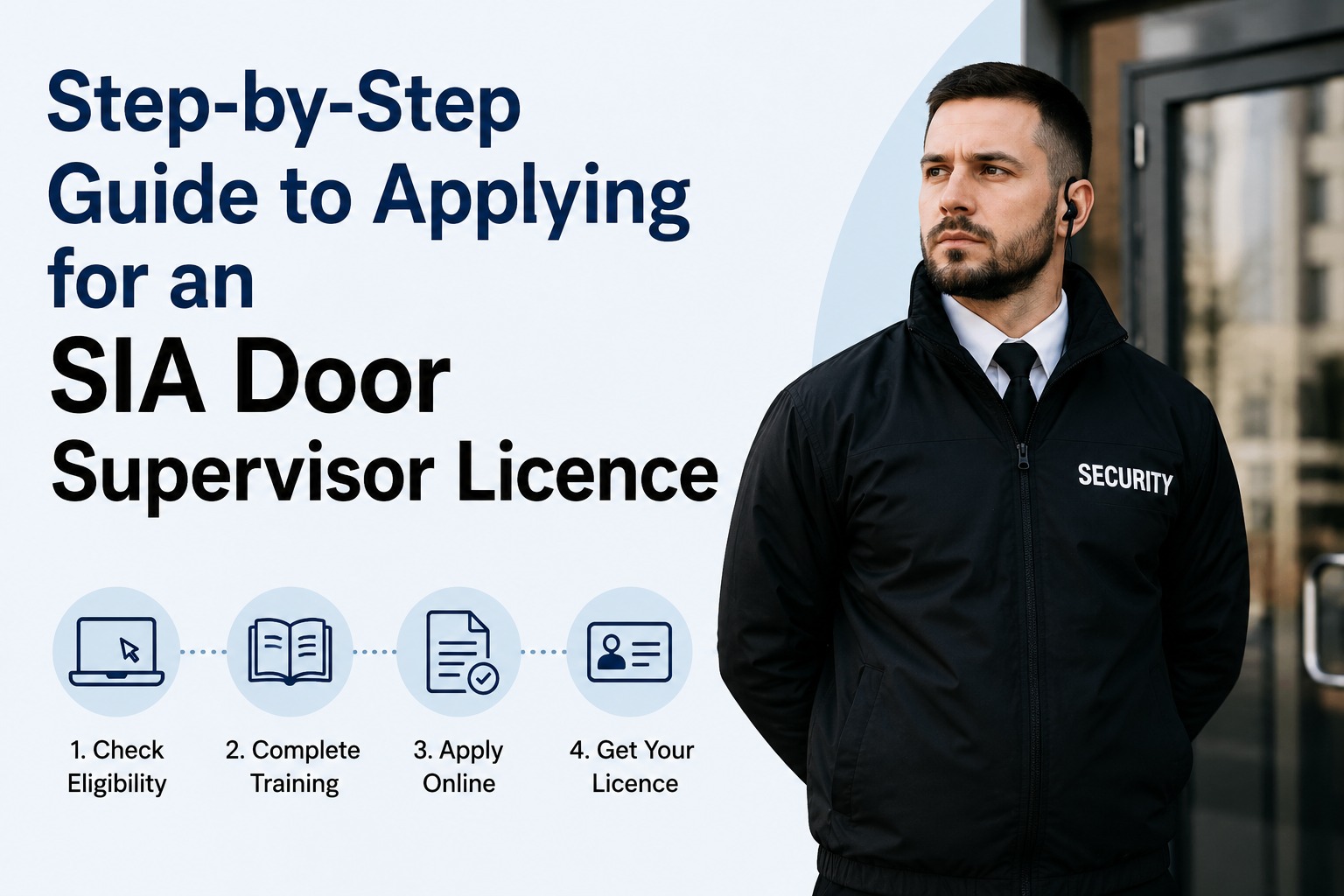
Somewhere in the UK tonight, a queue is forming outside a venue, and the person checking IDs at the front of it is doing a job that didn’t exist in its current form twenty years ago. Door supervision became a formally licensed profession under the Private Security Industry Act 2001, and since then, every single person working that door has needed to prove they’re trained, vetted, and legally entitled to do it. If you’re thinking about joining them, you’ve probably already found that the process looks more complicated on paper than it actually is.
That’s what this guide is for. If you’re ready to apply for SIA door supervisor licence approval, you’ll find every step in order below, the real 2026 costs, and the honest timeline, so you can plan properly rather than guessing.
What the SIA Actually Does
In the UK, the regulatory body for the private security industry is the Security Industry Authority. To be legally able to work as a Door Supervisor. You must pass through a specific sequence before you can obtain an SIA licence:
- Eligibility
- Training
- Application
- Verification
- Vetting
Think of it less like a single form and more like flat-pack furniture. Miss a step in the instructions, and you don’t get to carry on regardless. You have to go back and fix it before you can move forward.
Step 1: Check You’re Eligible
Before you spend a penny, confirm the basics:
- You’re 18 or over on the first day of training.
- You have the legal right to work in the UK.
- You can read, write, speak, and listen in English to a reasonable standard.
- You don’t hold convictions that would automatically bar you (having a criminal record doesn’t rule you out on its own; it depends on the offence).
One detail catches out more applicants than any of the above: name and address consistency. If your passport, driving licence, and utility bills don’t match exactly, you’ll hit delays later. Sort this before you book anything, since it’s far easier to fix now than once you’re ready to apply for SIA door supervisor licence approval.
Step 2: Get Your First Aid Qualification First
Here’s something that surprises a lot of new applicants: since April 2021, you must hold a valid Emergency First Aid at Work (EFAW) certificate, or an accepted equivalent, before you can even start your door supervisor training. It’s not something you pick up afterwards.
EFAW is typically a one-day course and usually costs around £100. If you’d rather complete a more thorough qualification that also satisfies this requirement and carries more weight with employers, our First Aid at Work course runs over three days and covers considerably more ground.
Step 3: Complete the Level 2 Door Supervisor Course
This is the core of the process: the Level 2 Award for Working as a Door Supervisor within the Private Security Industry, delivered by an SIA-approved training provider.
What it involves:
- Minimum contact time of 44 guided learning hours, delivered over 6 days (with some self-study built in, bringing total learning time closer to 60 hours).
- Course fees generally range from £249 to £350, separate from the SIA application fee.
The four units you’ll cover:
- Working in the Private Security Industry – the legal framework, health and safety, and safeguarding basics.
- Working as a Door Supervisor – the practical realities: searching, licensing law around alcohol and drugs, and crowd management.
- Conflict Management – de-escalation, communication, and staying professional under pressure.
- Physical Intervention Skills – lawful, safety-first physical techniques, taught strictly as a last resort.
The physical intervention unit has to be taught and assessed in person; it can’t be done online. Our Full SIA Door Supervisor course covers all four units and includes the practical assessment days you’ll need.
Step 4: Submit Your Application Online
This is the step where you formally apply for SIA door supervisor licence approval. Once you’ve passed your course, you’ll apply through the official SIA licensing service on GOV.UK. You’ll need to set up an SIA online account if you don’t already have one, then gather:
- Your training certificate.
- Your EFAW (or equivalent) certificate.
- A valid photo ID, such as a passport or UK driving licence.
- Two separate proofs of your current address.
- A full five-year address history with no gaps.
Fill this in carefully. Once submitted, you can’t simply amend your details, so it’s worth reading everything twice before you hit send.
Step 5: Pay the Application Fee
As of 1 April 2026, the SIA licence application fee is £204, up from £184. The change marks the end of a temporary rebate the SIA had been applying since 2020; the regulator’s chief executive, Michelle Russell, has pointed out that even at £204, the fee remains lower in real terms than the £190 charged when licensing began in 2004. The fee is non-refundable, whatever the outcome of your application.
A realistic total for a new applicant in 2026:
EFAW (~£100) + course fees (£249–£350) + SIA application fee (£204) = roughly £550–£650 all in.
Step 6: Verify Your Identity at the Post Office
After you submit online, the SIA will typically send you a code and ask you to visit a participating Post Office. Take your ID documents, proof of address, and the code with you. Staff there will check your documents against your application and take a digital photo of your licence card. In some cases, identity can instead be verified by a countersignatory, though the Post Office route is by far the most common.
Step 7: The Background Checks
While you wait, the SIA runs a criminal record check and confirms your right to work. If you’ve spent six months or more outside the UK in the last ten years, you may need to provide overseas criminal record evidence as well.
Processing usually takes around 25 working days, though it can stretch to six weeks if additional checks are needed. Here’s the part most guides skip: the single biggest cause of delay isn’t the criminal record check; it’s applicants’ own paperwork. Mismatched names, incomplete address histories, and expired IDs cause more hold-ups than anything the SIA itself is doing. If you want to move through this quickly, the leverage is almost entirely in your hands at Step 1 and Step 4.
Step 8: You’re Licensed. Now What?
If your application is approved, you can start working immediately. Even before your physical licence card arrives, as long as you carry your licence-granted letter and photo ID. Your card itself should turn up within about 14 days. Your licence is then valid for three years.
From there, many door supervisors go on to add complementary qualifications. A Security Guarding licence, for instance, sits alongside door supervision naturally, since anyone holding a Door Supervisor licence is also entitled to work as a security guard.
Before You Go
Getting licensed is genuinely a straightforward process once you see the order it needs to happen in: first aid, then training, then application, then verification, then the wait. The mistakes that cost people time are almost always avoidable ones: mismatched details, incomplete history, missing documents. Get those right from the outset, and there’s no reason this shouldn’t run smoothly from your first day of training to your first shift on the door.
When you’re ready to apply for SIA door supervisor licence approval, having each of these pieces in place from the outset is what makes the difference between a smooth application and a delayed one.
FAQs
What is the total cost of getting an SIA Door Supervisor Licence in 2026?
The total cost typically ranges from £550 to £650. This includes Emergency First Aid at Work training (around £100), the Door Supervisor course (£249–£350), and the SIA application fee (£204 from 1 April 2026). The £204 fee covers background checks and producing your three-year licence card.
What training do I need before applying?
You need two qualifications. First, a valid Emergency First Aid at Work (EFAW) certificate or accepted equivalent must be completed before you can start Door Supervisor training. Second, the Level 2 Award for Working as a Door Supervisor within the Private Security Industry, a course with a minimum of 44 guided learning hours delivered over 6 days. It covers four units: working in the private security industry, door supervision skills, conflict management, and physical intervention skills.
How do I actually apply for the licence?
To apply for SIA door supervisor licence approval, you’ll do it online through your SIA online account on the official GOV.UK portal. You’ll need to complete all sections of the application form (you can’t change details after submission), pay the £204 fee, and complete the “next steps” process, usually an identity check at a Post Office where staff verify your documents and take your photo.
How long does the application process take?
Processing typically takes up to 25 working days, around 2 to 6 weeks. Delays can occur if your identity documents are incomplete, your address history has gaps, or you’ve spent 6 months or more outside the UK in the last 10 years, which may require overseas criminal record checks.
Can I start working before my physical licence card arrives?
Yes. If your licence is granted, you can start work immediately in that sector, even if your photocard hasn’t arrived yet. You must carry your licence-granted letter and a photo ID until your badge arrives, which should be within 14 days of the licence being granted.
Can my employer apply for the licence on my behalf?
Yes, but only if your employer is an SIA-approved contractor. If they apply for you, you’ll still need to create a personal SIA online account, link it to your employer’s account, and provide your identity documents when asked, but your employer handles the submission and, in many cases, the fee.
What causes application delays?
The most common causes are gaps or errors in your five-year address history, mismatches between the name or spelling on different ID documents, uploading unclear or expired certificates, and time spent overseas: 6 months or more outside the UK in the last 10 years can trigger extra checks.
How long is the licence valid for, and what about renewal?
Your SIA Door Supervisor Licence is valid for 3 years. To renew, you’ll need to complete mandatory refresher training, a requirement introduced on 1 April 2025 for door supervisors and security guards, along with a valid first aid certificate before taking the refresher course. The renewal fee is the same as the application fee.
Do I need a licence to work as a door supervisor in the UK?
Yes. It’s a legal requirement to hold a valid SIA Door Supervisor Licence to work in licensed door supervision roles in the UK, including pubs, bars, nightclubs, and events.
What if I have a criminal record? Can I still get a licence?
The SIA provides a criminal record check on all applications. Some convictions may make you ineligible for a licence, but each case will be treated on a case-by-case basis and will take into consideration the nature of the offence, how recent it was and whether it is relevant to the security industry. There is a published set of criteria for licenses that you can find on the SIA’s website, and if you aren’t sure about your application, you should check the criteria before submitting your application.
This is custom heading element
These six principles are still applicable when working in writing: make it relevant right from the start; allow for self-directed options (e.g., choice of pace or module sequence); allow for discussion and the sharing of experiences; make use of problem-centred activities; allow for personal motivation (e.g., progress and recognition).